Tuesday, November 12, 2019

Reading Notes: English Fairy Tales, Part A

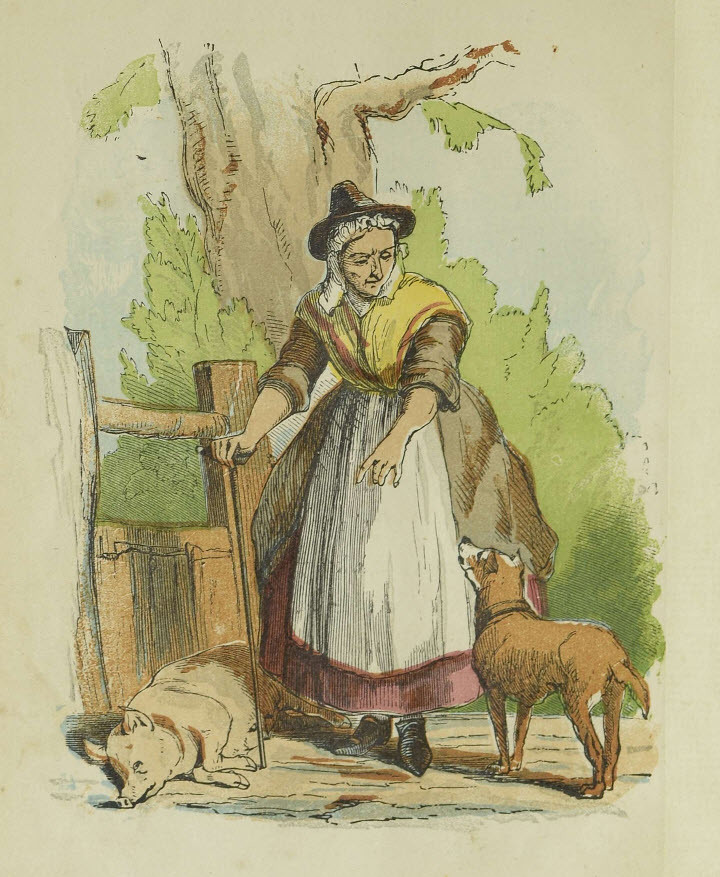
(Old Woman and Her Pig. Source)


  • One day an old woman found some extra money laying around in her home so she decided to go and buy a pig.
  • As she was coming home, they came upon a stile and the pig wouldn't go over it
  • She asked a dog to bite the pig so it would go over the stile but the dog wouldn't
  • She asked a stick to beat the dog so the dog would bite the pig so it would go over the stile but the stick wouldn't
  • She asked a fire to burn the stick so the stick would beat the dog so the dog would bite the pig so it would go over the stile but the fire wouldn't
  • She asked water to quench fire so fire would burn the stick so the stick would beat the dog so the dog would bite the pig so it would go over the stile but the water wouldn't
  • She asked an ox to drink water so water would quench fire so fire would burn the stick so the stick would beat the dog so the dog would bite the pig so it would go over the stile but the ox wouldn't
  • She asked a butcher to kill ox so the ox would drink water so water would quench fire so fire would burn the stick so the stick would beat the dog so the dog would bite the pig so it would go over the stile but the butcher wouldn't
  • She asked rope to hang butcher so butcher would kill ox so the ox would drink water so water would quench fire so fire would burn the stick so the stick would beat the dog so the dog would bite the pig so it would go over the stile but the rope wouldn't
  • She asked rat to gnaw rope so rope would hang butcher so butcher would kill ox so the ox would drink water so water would quench fire so fire would burn the stick so the stick would beat the dog so the dog would bite the pig so it would go over the stile but the rat wouldn't
  • She asked cat to kill rat so rat would  gnaw rope so rope would hang butcher so butcher would kill ox so the ox would drink water so water would quench fire so fire would burn the stick so the stick would beat the dog so the dog would bite the pig so it would go over the stile but the cat wouldn't
  • She asked the cow for some milk so she could give it to cat. Cow asked for hay. The old woman got some hay for the cow and she got milk in return that she then gave to cat. Then cat began to kill the rat; rat began to gnaw rope; rope began to hang butcher; butcher began to kill ox; ox began to drink water; water began to quench fire; fire began to burn stick; stick began to beat dog; dog began to bite pig; pig jumped over the stile; woman went home with the pig


Bibliography
English Fairy Tales: The Old Woman and Her Pig by Joseph Jacobs

Thursday, November 7, 2019

Week 12 Lab: TEDEd Videos on Language

(This week's lab is a series of TEDEd videos on language. Source)

How Languages Evolve

  • The thousands of languages that exist today can be traced back to a much smaller number
  • The world used to have a much smaller population. As population grew, groups split and separated from the main group, creating their own new languages
  • Languages can be shown to be related to each other through shared syllables, pronouns, numbers, etc
How Did English Evolve?
  • English comes from Anglo-Saxon (Old English) of the British
  • Old Norse combined with Anglo-Saxon. Then bits of Latin and French was incorporated. All of this adapted the English language
How many verb tenses are there in English?
  • There are aspects that further divide the common verb tenses (Past, Present, and Future) 
    • Continuous/Progressive Aspect - actions are still happening at the time of reference
    • Perfect Aspect - actions that are finished
    • Perfect Progressive Aspect - combination describing the continuous part of a completed action
    • Simple Aspect - basic form of past, present, or future tense where action isn't specified as continuous or discreet
Are Elvish, Klingon, Dothraki, and Na'vi real languages?
  • They are all conlangs, which are real languages
  • What makes a languages real?
    • Grammar
    • Change over time
    • Exceptions
Where do new words come from?
  • From other languages
    • English gets over half of its vocabulary from other languages
    • Sometimes another language has a better word to describe something
  • Combining existing words that each have part of the new concept
  • Old words acquiring new meanings
  • Ordinary people that have the right combination of useful and catchy
How to use a semicolon?
  • Fills the space inbetween a comma and a period
  • Links together independent clauses
When to use apostrophes
  • Mark possession, contraction, or pluralization with single letters
Does grammar matter?
  • Descriptivism - how a language is actually be used
  • Prescriptivism - how a language should be used


Bibliography
How Languages Evolve by Alex Gendler
How Did English Evolve? by Kate Gardoqui
How many verb tenses are there in English? by Anna Ananichuk
Are Elvish, Klingon, Dothraki, and Na'vi real languages? by John McWhorter
Where do new words come from? by Marcel Danesi
How to use a semicolon? by Emma Bryce
When to use apostrophes by Laura McClure
Does grammar matter? by Andreea S. Calude

Tuesday, November 5, 2019

Reading Notes: King Arthur, Part B

(Sir Lancelot. Source)

Sir Lancelot and the Five Hundred Knights

  • When Lancelot went through the forest, he met lots of the hermits that lived there. They told him that Sir Galahad, his son, sat in the Siege Perilous, which was saved for the best knight in the world.
  • Lancelot left the forest and came upon a plain of land with a castle. Around the castle were 500 knights on horses. The knight close to the castle were on black horses and the ones further from the castle were on white horses and they fought against each other
  • The black knights seemed to be getting beat by the white knights so he helped them. He defeated many of the white knights but he eventually grew tired. Once he was too tired the white knights took him to the forest
  • This confused Lancelot because he thought he was the best knight but he was shamed into thinking he was sinful
  • Then he rode until he came upon a chapel where he found a nun. He told her who he was and what happened at the tournament and the vision he had in his sleep
  • She told him that what happened was a dream. Lancelot represents both the earthly black knights, who were not yet purged of their sins, and the heavenly white knights. He helped the black knights because he thought they were his peers. She warns him of everlasting pain because he doesn't have any peers 


Bibliography
King Arthur: Tales of the Round Table by Andrew Lang

Reading Notes: King Arthur, Part A

(Vivien closing the rock over Merlin. Source)

The Passing of Merlin

  • Merlin fell in love with a lady of the lake and always wanted to be around her
  • Knowing that he loved her, she used this to her advantage and made him share all of his knowledge with her. He knew he shouldn't but he couldn't help himself
  • Merlin knew that one day he would be buried alive but he refused to try and change his fate
  • Merlin and Vivian left Arthur's Court and traveled to lots of places.
  • Eventually Vivian got tired of Merlin and wanted to kill him
  • One day Merlin took her to a big rock and told her of the great marvels that were underneath it. Then Vivian seduced Merlin into going underneath the rock to show her the marvels he was talking about. Once he was under the stone, she used the magic he taught her and rolled the stone over him, burying him alive
    • Wouldn't he be able to get out?
    • What if Merlin did try to prevent his death?


Bibliography
King Arthur: Tales of the Round Table by Andrew Lang

Thursday, October 31, 2019

Extra Credit Reading Notes: Mythology Overview

(Plato, the first to equate myths with lying. Source)

What is Myth? Crash Course World Mythology #1

  • A myth in the context of mythology is a story that has significance and staying power
    • Significance - the story is important to the reader in some way. Ex. something important, how the world works, or how things are the way they are
    • Staying power - Stories that last over multiple centuries and generations, which is a sign that the story has great meaning to those people
  • The "American Dream" is a myth, not because of religious significance like other myths, but because of its staying power
  • The "Persephone" myth has significance by explaining why we have seasons
Theories of Myth: Crash Course World Mythology #12
  • Mythology - systematic study of myths
  • Plato was the first to equate myths with lying, which is an idea that still exists today. He reasoned that because myths were irrational then they were false. However he deemed that philosophical myths that "served a purpose" were true
  • Myths from multiple languages were derived from a single language known as Prodo-Indo-European, which came from a group called Ayrians.
  • Anthropologists who studied myth say it's not symbolic but instead a direct expression of subject matter by expressing and enhancing beliefs, safeguarding and enforcing morality, and contains practical rules for the guidance of man
  • Psychologists Freud and Jung claim that the source of myths are from the subconscious and mythical characters are projections of the unconscious
  • Structural theory breaks down myths into a structure of patterns


The Hero's Journey and the Monomyth: Crash Course World Mythology

  • What are heroes?
    • Contemporary scholars say that we are all heroes in a way, struggling in our own adventures and engaging in our self development and finding our purpose in life
  • Monomyth - the idea that all heroic stories follow a certain pattern
    • Part One: The hero leaves the known world and goes to the realm of the unconscious
      • Initiated by a Call to Adventure
    • Part Two: The hero's trials and victories of initiation, changing into the person they're destined to be along the way
      • The exciting part consisting of tasks they have to overcome to prove their worthiness
      • Hero achieves enlightenment, taking an object that symbolizes this
    • Part Three: Hero's integration to society
      • More common in older myths than the modern ones
      • Ends with hero living happily ever after


Bibliography
What Is Myth? Crash Course World Mythology #1 by CrashCourse
Theories of Myth: Crash Course World Mythology #12 by CrashCourse
The Hero's Journey and the Monomyth: Crash Course World Mythology #25 by CrashCourse

Tuesday, October 29, 2019

Reading Notes: Native American California/Southwest, Part B

(The beautiful Bluebird after getting its blue feathers. Source)


  • Bluebird was not always blue. He used to be a very ugly color.
  • He found a lake that didn't have a river connected to it and bathed there four times every morning for four mornings. Every time he took a bath he sang a magic song
    • Change song to roses are red, violets are blue?
  • After the fourth bath on the fourth morning, Bluebird shed all his feathers and spent the day without any feathers. When he took a bath the next morning, he came out of the lake with blue feathers
    • Maybe Bluebird doesn't lose the feathers but they just go colorless on the 4th day?
  • Coyote crossed paths with Bluebird and was curious on how he turned blue. Bluebird told him, and since he also wanted to be blue, he bathed in the lake four times for four mornings, singing the song each time
  • On the fifth day, Coyote came out blue. He was so proud of his new color that he went around showing it off to all the other animals. He got distracted of all this new attention that he ran into a stump, covering the blue with dust.
    • Maybe Coyote fell off a cliff and rolled down it instead?


Bibliography
How Bluebird and Coyote Got Their Colors by Katharine Berry Judson

Reading Notes: Native American California/Southwest, Part A

(The cunning Coyote. Source)


  • The world was created. There were fishes in the water, animals on the land, and Man
    • What about the fish in the water?
  • No food hierarchy to determine which animals are predator and prey with each other and which were supposed to be food for Man
  • They were all to meet so that Man can determine this for the animals
  • Man would determine this by giving all the animals bows and arrows, the longest ones given to the top of the food chain and the shortest ones to the bottom of the food chain
  • The day before the meeting, all the animals gathered in the area and went to sleep to meet Man in the morning
  • Coyote, more cunning than all the other animals, pretended to sleep and stayed awake all night so that he could meet Man first and get the longest bow and arrow
  • Coyote stayed awake all night but in the morning he got too tired and couldn't help but fall asleep
    • What did he do during the night? Why couldn't he stay awake?
  • When morning came, the animals went to meet Man. Cougar got the longest bow, Bear got the 2nd longest, and so on until Frog got the 2nd shortest bow. There was still one bow left but no animal to give it to
  • They found out that Coyote was still asleep and took him to Man, who gave him the shortest bow
  • Man took pity on Coyote and asked Kareya to give Coyote more cunning
  • Coyote was now the most cunning out of all the animals. With this cunning he befriended Man and did many things for him

Notes
  • Creator name - Change to Great Spirit
  • Animals had some kind of contest to determine food hierarchy - Arm Wrestling Tournament?
    • Coyote cheated, did good at beginning but got caught and given lowest rank
    • Man took pity and gave Coyote cunning


Bibliography
The Fable of the Animals by Katharine Berry Judson